
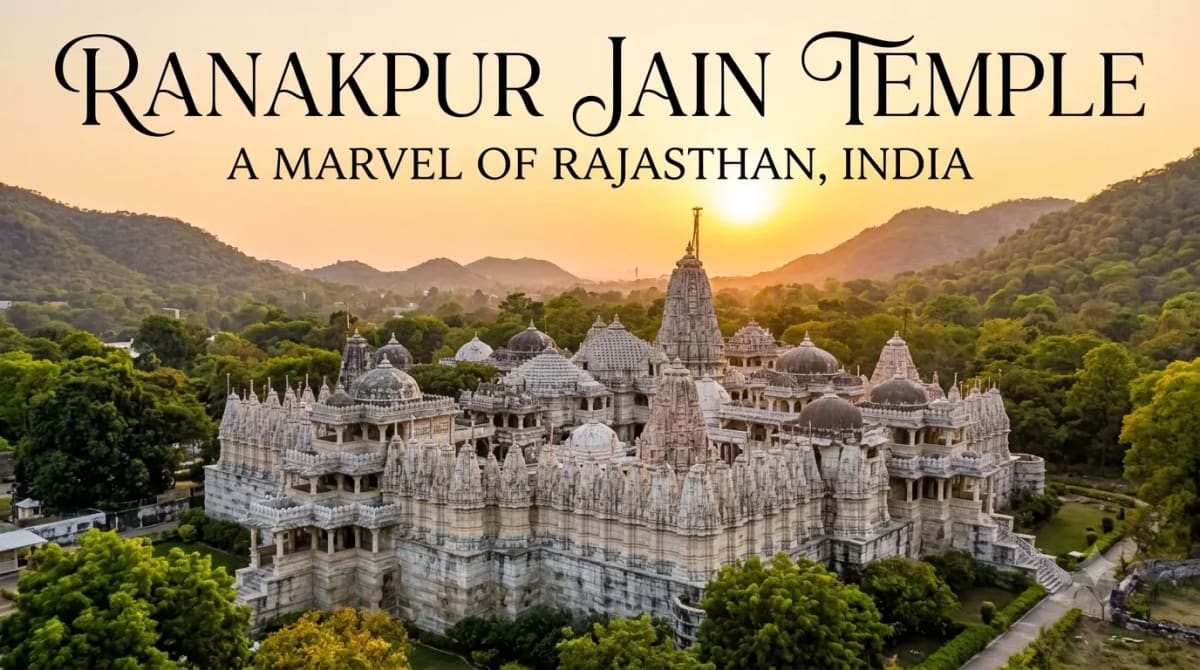
Ranakpur Jain Temple, located in Rajasthan’s Pali district in the Aravalli hills, is one of India’s most significant Jain pilgrimage sites. Also known as the Chaumukha Mandir or Adinatha Temple, it is dedicated to Lord Adinatha (Rishabhanatha), the first Tirthankara in Jainism. The temple is renowned for its intricate white marble carvings, beautifully designed domes, and numerous pillars arranged to preserve views of the main shrine. Its religious importance and remarkable architecture make it a worthwhile stop for travellers exploring Rajasthan, particularly those travelling between Udaipur and Jodhpur.
Ranakpur Jain Temple: The Marble Dream Behind Rajasthan's Most Remarkable Jain Shrine
Most temples ask you to look up. Ranakpur asks you to keep turning around.
Step inside the Ranakpur Jain Temple and the pillars seem to repeat in every direction, yet no matter where you stand, they leave a clear line of sight to the main shrine. Domes open overhead in rings of carved marble. Light falls differently in each hall. It is one of the most important Jain pilgrimage sites in India, and for anyone driving between Udaipur and Jodhpur, it is the one stop that is worth planning the whole day around.
This guide covers the history of Ranakpur, the people behind it, what makes the architecture so unusual, what is in the rest of the complex, and the practical details you need before you visit.
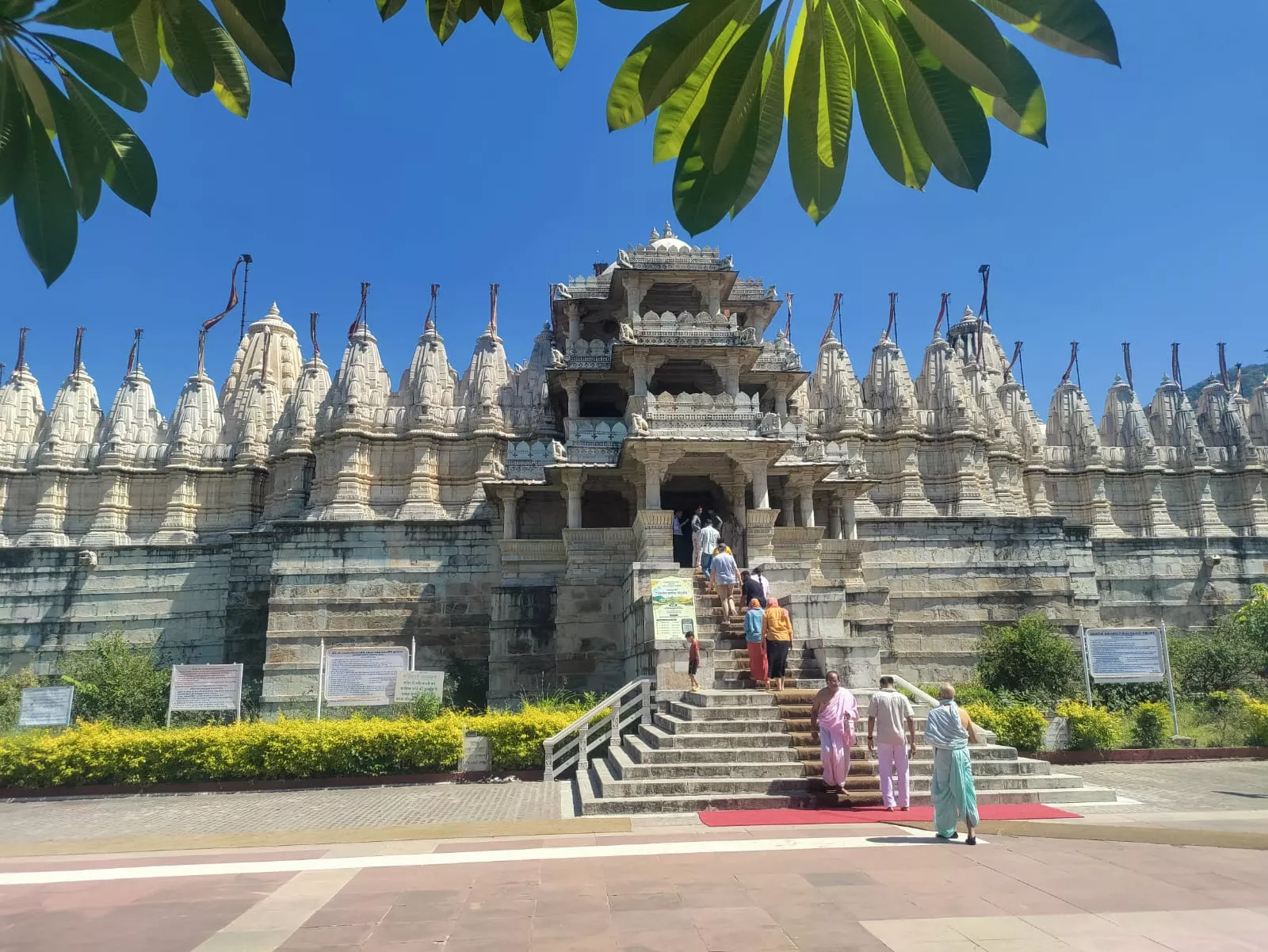
Where is Ranakpur and why does it matter?
Ranakpur is a village in the Desuri tehsil of Pali district, Rajasthan, in a valley on the western side of the Aravalli range. It sits roughly between Udaipur and Jodhpur, which is why it works so well as a stop on the road between the two cities. The nearest town of any size is Sadri, a few kilometres away, and Falna is the closest railway station.
The reason it matters is religious as much as architectural. The Ranakpur Jain Temple, also called the Chaumukha Mandir, the Adinatha Temple or Dharan Vihar, is a Śvētāmbara Jain temple and is counted among the five major pilgrimage sites of Jainism. It is dedicated to Adinatha, also known as Rishabhanatha, the first Tirthankara.
The dream that started it all
Every account of Ranakpur begins with a dream.
According to Jain tradition, a merchant named Dharna Shah (also written Dharanashah, Dhanna Shah or Dharanak, depending on the source) saw a celestial vehicle in a dream. This is called a nalini-gulma vimana, a heavenly flying palace of pillars and halls. He resolved to build a temple in its image.
Dharna Shah was not only a wealthy Jain merchant from a family that held the title of Sanghapati, someone who has borne the cost of a community pilgrimage. According to Jain tradition he also rose to become a minister in the court of Rana Kumbha, the ruler of Mewar. That relationship is the reason Ranakpur exists in its present form. Rana Kumbha gave land for the temple and for a township, and the place took its name from the king: Ranakpur, "Rana's town."
The temple's own tradition credits four people for its creation: the Jain monk Acharya Somasundarsuri, the minister Dharna Shah, Rana Kumbha, and the architect, usually named as Depaka (Depa, Deepaka or Dwepa in different sources).
What the 1439 inscription tells us
Temple legends can drift over centuries, so historians look at inscriptions. An inscription dated 1439, on a pillar near the main shrine, names Dharna Shah as the builder and Depaka as the architect. A longer record associated with the temple describes Rana Kumbha as the principal initiator of the project, which tells us the king saw the temple as his own undertaking as well as the merchant's.
The same tradition says the main structure was inaugurated around 1441 in the presence of Dharna Shah and his teacher Somasundarsuri. Later work continued for years.
Why you will see different dates
You will find conflicting dates across the internet, from the late 14th century to the mid-15th. Scholars generally agree the temple belongs to the 15th century, but the exact start and finish are debated. A popular account says construction took around fifty years. Jain sources note the oddity in that claim, since a man who started the project as an adult and finished it half a century later would have been very old.
The honest summary is this: the temple was conceived and substantially built in the 15th century under Rana Kumbha's patronage, with the 1439 inscription as the firmest anchor. Treat any single start-to-finish date you read as a tradition rather than a certainty.
The architecture: what you are actually looking at
Ranakpur is built almost entirely of pale marble and follows the Māru-Gurjara style of western India. The footprint is roughly 48,000 square feet, and the plan is a chaturmukha-prasada, a four-faced temple. The main shrine holds a white marble image of Adinatha, about six feet tall, in the lotus posture, with faces turned toward all four cardinal directions. There are four entrances, one for each.
The 1,444 pillars
The number that appears in nearly every description is 1,444 pillars, and the claim that no two are alike. It is a popular belief rather than a figure confirmed by a systematic survey, so it is best repeated as "reportedly" or "traditionally." What you can verify by walking through is that the pillars are numerous, carved with great variety, and arranged so that they do not block the view of the main image from most positions.
Some pillars rise to about 40 feet in the central hall, often called the Meghnad Mandap, which carries a dome built around an inverted lotus.
Halls, domes and spires
Descriptions commonly count 29 halls and around 80 domes beneath five shikharas (spires), with the central one the largest. Each dome is carved in concentric bands. Between the base and the crown, brackets show deities and celestial figures, including musicians and dancers, the apsaras and divine attendants you will see all over the ceilings.
Around the central shrine are the images of the 24 Tirthankaras. The temple is also said to be surrounded by 84 subsidiary shrines.
Carving that looks like lace
The carvings in Ranakpur are the reason people stand still. Foliage, geometric patterns, figures and scenes are cut into marble so finely that, in places, it reads like lace or carved chains. One carved marble leaf of the kalpavriksha, the wish-fulfilling tree of Jain tradition, is believed by devotees to grant wishes. On one pillar, the figures of Dharna Shah and the architect Depaka are said to be depicted, a rare acknowledgement of the people behind the work.
[IMAGE 2: Close-up of a carved pillar or dome ceiling] Alt text: Carved marble ceiling and pillars inside the Ranakpur Jain Temple. (Only use photos where photography is permitted. See visitor rules below.)
Built to protect
The complex was designed with an eye to safety as well as beauty. Accounts mention underground chambers, often called bhonyra or cellars, built to protect the idols during times of conflict. The numbers differ between sources (some say nine, others say 84), so it is better to describe them as "several."
The people and politics behind the marble
It helps to place Ranakpur in its time. Rana Kumbha ruled Mewar from the 1430s to the 1460s, and under him the kingdom grew to something close to an empire. He is remembered as a builder of forts (including Kumbhalgarh, around an hour's drive away), a patron of the arts and a skilled administrator.
The fact that a Hindu Sisodia king backed the construction of a Jain temple on this scale says something about Mewar's religious landscape in that period. Jain merchants and ministers were influential in the court, and royal patronage of Jain temples was part of the political culture.
What happened after: neglect, care and restoration
Ranakpur's later history is less glamorous. Accounts describe how, as conflicts disturbed the region over the following centuries, the temple lost its congregation, fell into neglect, and was affected by invasions. The area gained a reputation for being unsafe, and the temple went through a long period of decline.
The revival came through the Jain community. In 1897 (Vikram Samvat 1953), the Sadri congregation passed the management of the temple to the Sheth Anandji Kalyanji Pedhi, a well-known Jain trust, which carried out long restoration work. The Archaeological Survey of India commented favourably on the restoration in its 1907–08 annual report. The same trust continues to look after the temple today.
What else is in the Ranakpur complex?
The Chaumukha temple draws most of the attention, but the surrounding temples reward a visit.
Parshvanatha Temple. Famous for an image of Sahastrafana Parshvanath, carved from a single stone with 1,008 serpent hoods and tails that intertwine in an unbroken pattern.
Neminatha Temple. Dedicated to the 22nd Tirthankara, with sculptural detail on its outer walls.
Sun Temple (Surya Temple) and Amba Mata Temple. Both close to the main complex and mentioned by Incredible India as worth including.
A Rayan tree. Tradition says it was planted by Dharna Shah and still stands in the complex.
There is also a pilgrim guesthouse (dharamshala) and a dining hall (bhojanshala), reflecting the site's role as a living pilgrimage centre rather than only a monument.
How to plan your visit to Ranakpur Jain Temple
Important: Timings, fees and photography rules at active religious sites change. The details below come from published sources and are meant as a planning guide, not a guarantee. Please confirm them locally or with the temple trust before you travel.
Visiting hours
This is the single most important thing to know. Several sources describe a split in access: Jain devotees can enter in the morning, while tourists and non-Jain visitors are generally admitted from around midday until about 5 PM. If you arrive at 9 AM expecting to walk in, you may be asked to wait.
Plan to arrive around noon. That also helps you avoid the morning worship period and gives you a calmer experience inside.
Entry fee, cameras and audio guides
Entry for general visitors is commonly described as free or nominal for Indian visitors, with separate charges for cameras and audio guides, and different fees for foreign visitors. One older source lists a camera fee of ₹100, but fees change, so treat it as a rough guide only. An audio guide is widely recommended, and some visitors report that guides are not allowed inside, so the audio guide may be the best way to understand what you are seeing. Carrying ID as a deposit for the audio guide is often mentioned.
Dress code and etiquette
Ranakpur is an active place of worship, and the following rules are widely reported.
Cover your shoulders, arms and knees. Shorts and sleeveless tops are commonly not permitted.
Remove your shoes before entering.
Leather items, such as belts and wallets, are often not allowed inside.
Keep your voice down and move slowly in prayer areas.
Photography is restricted, especially near the main shrine. Many visitors report that phones are collected at the entrance during some hours, and photography is allowed only after midday in permitted areas. Always ask.
Some sources say women are asked not to enter during menstruation, in line with Jain temple customs. Visitors should be aware of this and respect the temple's rules.
Be careful with monkeys around the complex.
How to reach Ranakpur
From Udaipur: about 90 km by road, roughly two hours.
From Kumbhalgarh Fort: about 50 to 55 km, a drive of roughly an hour. The two sites make a natural pair because Rana Kumbha is connected to both.
By train: Falna is the nearest railway station, about 30 to 35 km away. Rani is also mentioned as a nearby station.
By air: Udaipur's Maharana Pratap Airport is the closest airport.
By road: Ranakpur lies on the route between Udaipur and Jodhpur, so a private car or taxi is the most flexible option.
Best time to visit
October to March is the most comfortable period, with pleasant weather for walking around the complex and the surrounding hills. Summers are hot, though the marble interior stays noticeably cooler than outside.
Combining Ranakpur with Kumbhalgarh and Jawai
Ranakpur fits neatly into a Rajasthan loop. The usual pairing is Kumbhalgarh Fort, built by the same Rana Kumbha, and the combination of fort and temple gives you two sides of Mewar's 15th-century story: military power and religious patronage. From there, Jawai and its leopard country are within driving distance, which is the route many group trips follow.
If you are planning that circuit, read our guide to Kumbhalgarh Fort: history, gates and temples and our travel story from a Jawai stranger trip from Indore.
A few things to understand before you go
Do not expect a museum. Ranakpur is a working temple with devotees, rituals and rules. The atmosphere is part of the experience.
Do not count the pillars. The number is traditional. Enjoy the variety instead.
Arrive prepared for the timing rule. Plan your day around the midday opening for tourists.
Carry water and wear comfortable footwear for the walk to and from the entrance, because you will be barefoot inside.
🗓️ Best Time to Visit
October to March
Best time to visit
October to March is the most comfortable period, with pleasant weather for walking around the complex and the surrounding hills. Summers are hot, though the marble interior stays noticeably cooler than outside.
🚗 How to Reach
By train
Falna is the nearest railway station, about 30 to 35 km away. Rani is also mentioned as a nearby station.
By air
Udaipur's Maharana Pratap Airport is the closest airport.
By road:
Ranakpur lies on the route between Udaipur and Jodhpur, so a private car or taxi is the most flexible option.
✈️ Related Trips from TravelTech

728 × 90 — Leaderboard
❓ Frequently Asked Questions
Who built the Ranakpur Jain Temple?
Why is it called Ranakpur?
How many pillars does Ranakpur Temple have?
Which Tirthankara is Ranakpur dedicated to?
What are the Ranakpur Jain Temple timings for tourists?
s photography allowed at Ranakpur?
How far is Ranakpur from Kumbhalgarh and Udaipur?
Who looks after the temple today?
How long do you need?
How long do you need?
📚 Related Guides
More Travel Stories
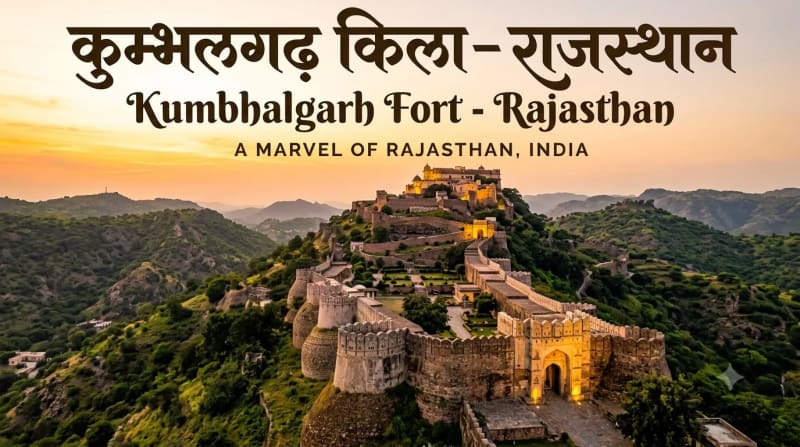
Kumbhalgarh Fort: History, 7 Gates, Temples, Badal Mahal & Complete Visitor Guide
Kumbhalgarh Fort explained using ASI information boards: Rana Kumbha's history, seven gates, Neelkanth and Parsvanatha temples, Badal Mahal and visit tips.
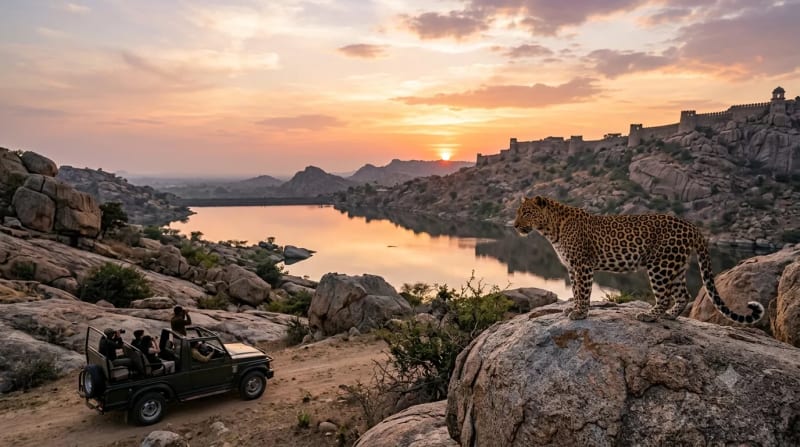
Jawai Stranger Trip from Indore: My Honest Experience
I joined a Jawai group trip from Indore as a solo traveller: Kumbhalgarh, Ranakpur, a leopard safari and strangers who became friends. Here's how it went.

Group Trips from Indore: Where Can You Travel With TravelTech?
Explore group trips from Indore with TravelTech. Visit Udaipur, Pachmarhi, Goa, Kashmir, Manali, Ladakh and Spiti with organised group travel.